> ## Documentation Index
> Fetch the complete documentation index at: https://docs.userogue.com/llms.txt
> Use this file to discover all available pages before exploring further.
# Organizational Segmentation Guide
> A strategic approach to structuring your Rogue implementation across business lines and subsidiaries
## Overview
For large enterprises with multiple subsidiaries, effective organizational segmentation within Rogue maximizes both security and efficiency. This guide outlines a strategic approach to structuring your Rogue implementation across business lines and subsidiaries.
## The Subsidiary-Based Approach
 Rogue's organization structure is designed to mirror your actual business structure, with each organization maintaining:
* Separately encrypted data
* Unique access controls
* Distinct capability statements
* Independent war rooms
## Key Benefits
* **Enhanced Data Protection**: Each subsidiary's proprietary information remains siloed
* **Customized Tone & Capabilities**: Tailor capabilities statements to each subsidiary's unique value proposition
* **Simplified Teaming**: Collaborate with partners on specific opportunities without exposing unrelated business data
* **Efficient Resource Management**: Keep proposal workspaces focused on relevant information only
## Implementation Guide
### Step 1: Create Separate Organizations by Subsidiary/Business Line
For each subsidiary or distinct business line:
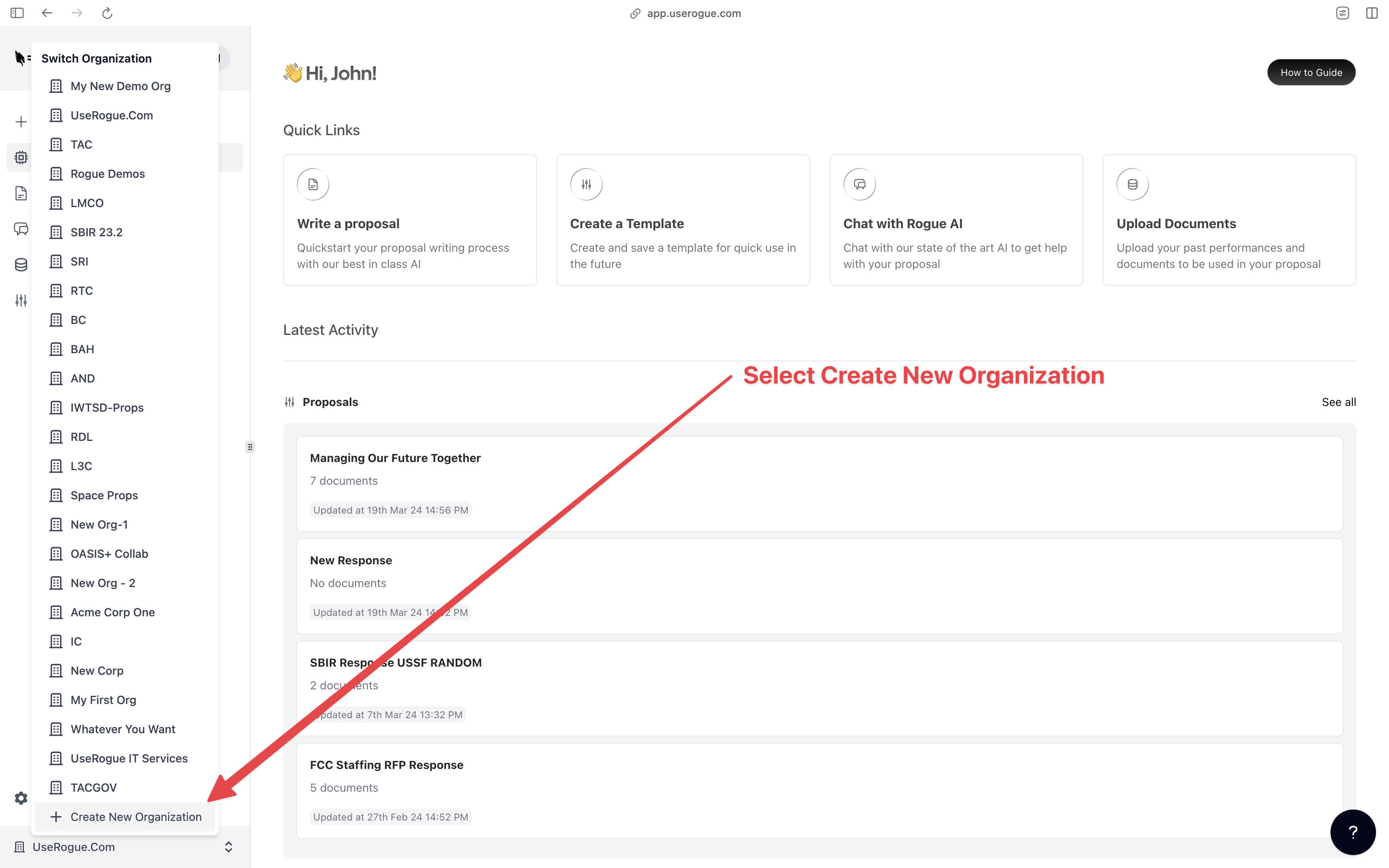
1. Click the "Organization" button at the bottom left of your screen
2. Select "Create new organization"
3. Name the organization clearly (e.g., "Acme Defense Systems," "Acme Healthcare Solutions")
4. Upload a unique profile image (typically the subsidiary's logo)
Use consistent naming conventions to make organization identification intuitive for users who belong to multiple organizations.
### Step 2: Customize Each Organization's Profile
For each subsidiary organization:
1. Set up a tailored capabilities statement that reflects that specific subsidiary's:
* Core capabilities and specializations
* Relevant NAICS codes and contract vehicles
* Unique past performance examples
* Target customer segments
2. Configure tone settings appropriate to each subsidiary's market position:
* Technical/scientific divisions may benefit from higher complexity settings
* Customer-facing divisions might use more accessible language
### Step 3: Establish Appropriate Access Controls
Invite only relevant personnel to each subsidiary organization:
* Core proposal team members
* Subject matter experts specific to that business line
* Executives overseeing that subsidiary
Consider role assignments carefully:
* Limit admin privileges to essential personnel
* Use base member roles for subject matter experts or occasional collaborators
### Step 4: Set Up Subsidiary-Specific Data Shelves
Populate each organization's data shelf with only the documents relevant to that subsidiary:
* Technical documentation specific to the subsidiary's offerings
* Past performance relevant to that business line
* Templates customized for that subsidiary's typical opportunities
Remember that documents uploaded to one organization are not accessible from other organizations, even for the same user. This is by design for data security.
## Best Practices for Enterprise Management
### Cross-Subsidiary Collaboration
When proposals require capabilities from multiple subsidiaries:
* Create a dedicated organization for the specific opportunity
* Invite team members from relevant subsidiaries
* Upload only the specific documents needed from each subsidiary
### Centralized Governance
For enterprise-wide consistency:
* Develop standard templates that can be adapted for each subsidiary
* Create documentation for organization naming and structure
* Establish clear processes for creating new organizations
### Efficient User Management
For users who work across multiple subsidiaries:
* Use the same email address for all organization memberships
* Train users on quickly switching between organizations
* Establish clear naming conventions for war rooms to avoid confusion
## Real-World Example
A large defense contractor with aerospace, maritime, and cybersecurity divisions might structure their Rogue implementation as:
| Organization | Capabilities Focus | Team Members | Data Shelf Content |
| --------------------------- | ------------------------------------------- | ---------------------------------------------- | ------------------------------------------------ |
| Acme Aerospace | Aircraft systems, avionics, satellite comms | Aerospace division proposal team, SMEs | Aerospace past performance, technical docs |
| Acme Maritime | Naval systems, underwater sensors | Maritime division proposal team, naval experts | Maritime past performance, ship specs |
| Acme Cyber | Network security, threat response | Cybersecurity team, security architects | Cyber certifications, security frameworks |
| Acme-Northrop Joint Venture | Combined proposal for major DoD contract | Select members from both companies | Only documents specific to the joint opportunity |
## Summary
By segmenting your Rogue implementation to match your company structure, you gain:
* Enhanced security through proper data segregation
* Improved proposal relevance with subsidiary-specific information
* Streamlined collaboration within business units
* Flexibility to create cross-subsidiary teams when needed
This approach scales effectively as your company grows or restructures, while maintaining information security and proposal efficiency.
Rogue's organization structure is designed to mirror your actual business structure, with each organization maintaining:
* Separately encrypted data
* Unique access controls
* Distinct capability statements
* Independent war rooms
## Key Benefits
* **Enhanced Data Protection**: Each subsidiary's proprietary information remains siloed
* **Customized Tone & Capabilities**: Tailor capabilities statements to each subsidiary's unique value proposition
* **Simplified Teaming**: Collaborate with partners on specific opportunities without exposing unrelated business data
* **Efficient Resource Management**: Keep proposal workspaces focused on relevant information only
## Implementation Guide
### Step 1: Create Separate Organizations by Subsidiary/Business Line
For each subsidiary or distinct business line:
1. Click the "Organization" button at the bottom left of your screen
2. Select "Create new organization"
3. Name the organization clearly (e.g., "Acme Defense Systems," "Acme Healthcare Solutions")
4. Upload a unique profile image (typically the subsidiary's logo)
Use consistent naming conventions to make organization identification intuitive for users who belong to multiple organizations.
### Step 2: Customize Each Organization's Profile
For each subsidiary organization:
1. Set up a tailored capabilities statement that reflects that specific subsidiary's:
* Core capabilities and specializations
* Relevant NAICS codes and contract vehicles
* Unique past performance examples
* Target customer segments
2. Configure tone settings appropriate to each subsidiary's market position:
* Technical/scientific divisions may benefit from higher complexity settings
* Customer-facing divisions might use more accessible language
### Step 3: Establish Appropriate Access Controls
Invite only relevant personnel to each subsidiary organization:
* Core proposal team members
* Subject matter experts specific to that business line
* Executives overseeing that subsidiary
Consider role assignments carefully:
* Limit admin privileges to essential personnel
* Use base member roles for subject matter experts or occasional collaborators
### Step 4: Set Up Subsidiary-Specific Data Shelves
Populate each organization's data shelf with only the documents relevant to that subsidiary:
* Technical documentation specific to the subsidiary's offerings
* Past performance relevant to that business line
* Templates customized for that subsidiary's typical opportunities
Remember that documents uploaded to one organization are not accessible from other organizations, even for the same user. This is by design for data security.
## Best Practices for Enterprise Management
### Cross-Subsidiary Collaboration
When proposals require capabilities from multiple subsidiaries:
* Create a dedicated organization for the specific opportunity
* Invite team members from relevant subsidiaries
* Upload only the specific documents needed from each subsidiary
### Centralized Governance
For enterprise-wide consistency:
* Develop standard templates that can be adapted for each subsidiary
* Create documentation for organization naming and structure
* Establish clear processes for creating new organizations
### Efficient User Management
For users who work across multiple subsidiaries:
* Use the same email address for all organization memberships
* Train users on quickly switching between organizations
* Establish clear naming conventions for war rooms to avoid confusion
## Real-World Example
A large defense contractor with aerospace, maritime, and cybersecurity divisions might structure their Rogue implementation as:
| Organization | Capabilities Focus | Team Members | Data Shelf Content |
| --------------------------- | ------------------------------------------- | ---------------------------------------------- | ------------------------------------------------ |
| Acme Aerospace | Aircraft systems, avionics, satellite comms | Aerospace division proposal team, SMEs | Aerospace past performance, technical docs |
| Acme Maritime | Naval systems, underwater sensors | Maritime division proposal team, naval experts | Maritime past performance, ship specs |
| Acme Cyber | Network security, threat response | Cybersecurity team, security architects | Cyber certifications, security frameworks |
| Acme-Northrop Joint Venture | Combined proposal for major DoD contract | Select members from both companies | Only documents specific to the joint opportunity |
## Summary
By segmenting your Rogue implementation to match your company structure, you gain:
* Enhanced security through proper data segregation
* Improved proposal relevance with subsidiary-specific information
* Streamlined collaboration within business units
* Flexibility to create cross-subsidiary teams when needed
This approach scales effectively as your company grows or restructures, while maintaining information security and proposal efficiency.